A Passion or an Obsession?
I've wanted a 3D printer since probably 2013. I always thought they were fascinating, but with the kind of work I was doing and the amount of time I spent away from home, I never really had the opportunity to learn how to use one. Besides, what was I going to do with it? Buy a machine, set it up, and then leave town for another week?
But there was something else. I'd had an idea in the back of my head for probably 15 years. Something related to the telecommunications industry that I thought could make people's jobs easier. I knew how I wanted it to work, and I could picture it in my head. The problem was that I didn't know how to turn that idea into an actual product.
Then AI came along. One day, I asked ChatGPT if it could help me learn how to operate a 3D printer and create CAD files. It said yes, and I ordered a printer that day. I didn't know anything about 3D printing or creating CAD files, but I figured if I had something to help me learn, I could probably figure it out.
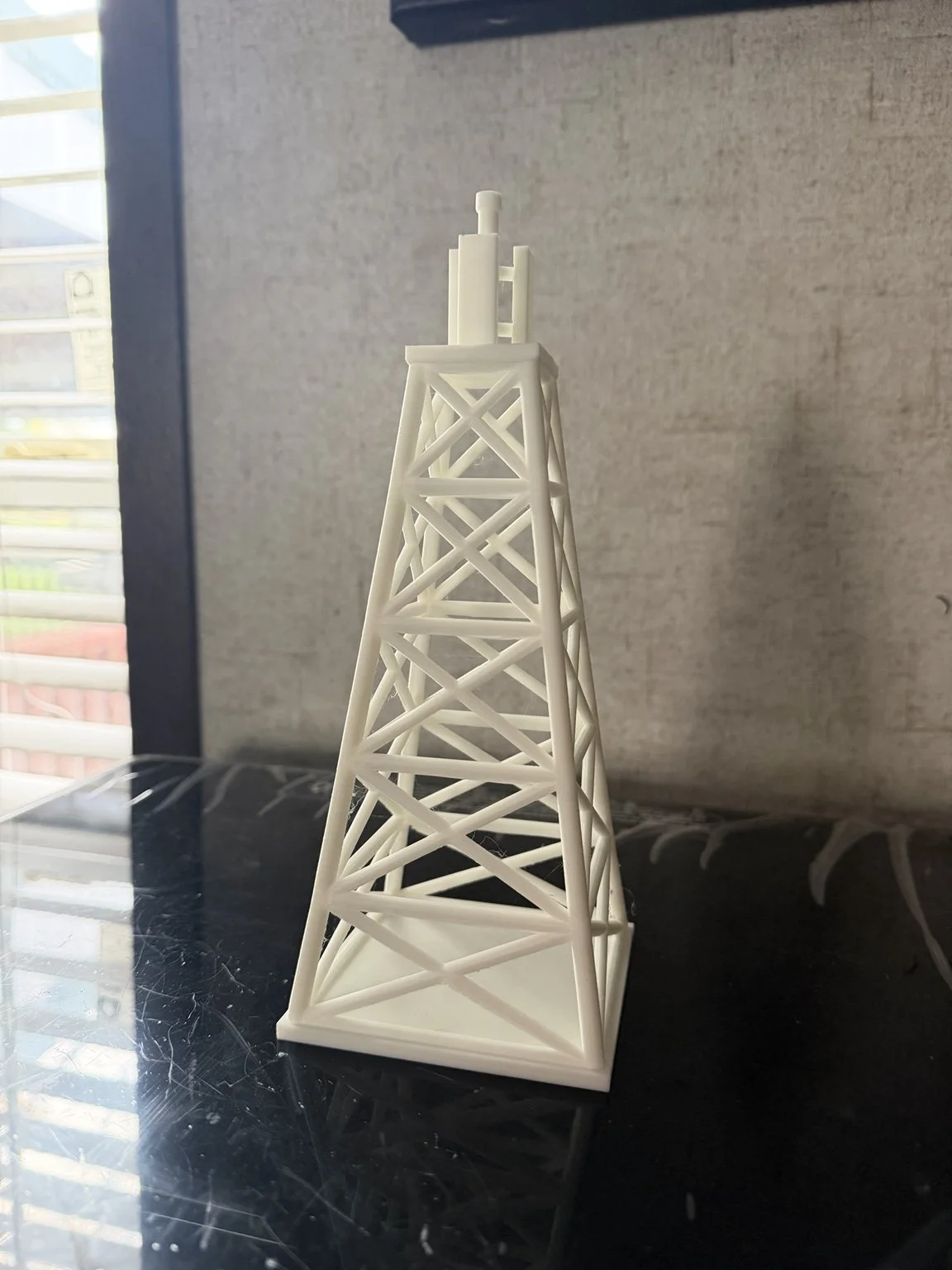
The first thing I printed was a telecommunications tower. Go figure. It's about 12 or 13 inches tall, and I've still got it sitting on my desk. It printed perfectly, too. Took a while, but I remember watching that thing build itself, layer by layer, and thinking how cool it was. The funny thing is, now that I've learned a little about supports, overhangs, and printing things that are practically hanging in midair, I'm surprised that tower even printed. Apparently, I didn't know enough back then to realize it shouldn't have worked.
After that, I got out my calipers. I already knew what I wanted to make. I'd been thinking about it for years, and now I finally had a way to try.
And that's when things started getting interesting. I'd spend two hours printing one part, another two hours printing another part, and then find out they wouldn't fit together. Or one would break. Or I'd put everything together, look at it, and decide I didn't like it. So, I'd spend another hour changing dimensions and start all over.
I was learning all of this as I went. I didn't know anything about supports or infill, and I was pretty much using the factory settings. I remember switching from PLA to PETG for the first time, and the printer kept plugging up. I couldn't figure out why. Well, I didn't even know you had to tell the printer what kind of filament you were using. That was another lesson.
There's a whole world of 3D printing out there. People sharing designs, communities where you can ask questions, and thousands of things you can download and print for free. You could probably spend years learning everything these machines are capable of doing. And here I was, trying to learn while developing my own product.
Eventually, I got tired of waiting. I'd have a five-hour print going, and my mind would already be three changes ahead of what the machine was making. Sometimes I'd finish a design, start printing it, and think of a better way to do it before the print was even finished. So, I decided I needed another printer. I figured I could let the larger one make several components while a smaller machine handled individual test pieces.
I named the big printer Foreman. He'd earned it. He was dependable, did his job, and I didn't have to stand there supervising him. The smaller printer became Green Hand. He was the new guy.
At first, Green Hand seemed to be doing all right, but then I started noticing things weren't fitting correctly. I got to looking closer and discovered the machine itself was damaged. It was supposed to be a certified-reconditioned printer. Well, it might have been certified, but it sure wasn't printing square. I was seeing differences of around three millimeters on a three-inch part. When you're making prototypes where the pieces have to fit together, that's not something you can work around.
So, I started working on sending Green Hand back, and about that same time, Foreman decided he wasn't going to cooperate anymore either. I had an overnight print go bad, and I spent a couple of days trying to figure out what was happening. Then came the first-layer problems, filament feeding issues, hot-end problems, and prints that would run for a couple of hours before the filament just stopped coming out. I even broke a gear along the way.
I could run a 13-hour print, take it off the machine, start another one, and suddenly the printer wouldn't behave correctly. I checked fans, checked settings, ordered a replacement wiring harness and a print-head circuit board, and adjusted the print bed with a feeler gauge. I tried just about everything I knew to try, which admittedly wasn't much when I started.
Foreman wasn't earning his title anymore. I left his name alone in the software, but I wasn't calling him Foreman for a while. With Green Hand going back and the other machine giving me fits, I decided to order a different brand of printer.
That's how New Guy showed up. Of course, the software was completely different, so now I had another learning curve. But New Guy worked, and he still does.
Eventually, I figured out something about the original printer. When I left the top cover off, most of those recurring problems disappeared. I still don't completely understand why, because I've checked the cooling fans and everything else I know to check, but it certainly appears to be heat related. I still have to watch his first layer. I've slowed it down considerably, and once that first layer is down correctly, I can usually leave him alone.
So, Foreman eventually earned his title back, and New Guy just keeps doing his job. Somewhere along the way, I've accumulated probably ten rolls of filament, five or six spare hot ends, and enough replacement parts to make you wonder whether I bought a 3D printer or started a repair shop. The funny thing is that I still feel like I've learned maybe ten percent of what these machines are capable of doing.
But here's the part that people might not understand when they see all this stuff. I'm not obsessed with 3D printing. I enjoy it. I think the technology is fascinating, and there's something pretty satisfying about watching an idea turn into something you can actually hold in your hand. But the printer is just a tool.
What I'm really working on is that idea I had 15 years ago, and that one idea has now grown into six or eight related ideas. I'll print seven or eight components of one size, assemble them, and see how everything fits. Meanwhile, I've already got another size printing. Then I'll look at what I've made and think maybe I could make it stronger, easier to install, or maybe there's a better way to lock the pieces together.
So, I change the design, and those five or six pieces I just spent hours printing are obsolete. I've gone through around eleven revisions on some of these designs, and I'm not talking about changing one little measurement. I've changed almost everything about how the parts go together. The one thing that hasn't changed is the original base concept. That's the part I had in my head all those years ago.
And I'm not trying to make something that just looks good sitting on my desk. If I'm going to take a prototype to a manufacturer, it needs to work. It needs to work repeatedly. It needs to be strong, easy to install, and visually appealing. It needs to look like something that belongs in a commercial or industrial environment. Most importantly, it needs to solve a problem and save somebody money. If it doesn't do those things, what good is it?
That's why I'll spend hours printing something, look at it for five minutes, and decide to start over. It's not always because something failed. Sometimes it's because I figured out a better way to do it.
I suppose somebody could look at the time I've spent, the money I've invested, the broken parts, and the piles of prototypes and wonder why I keep doing it. But I've always been that way. When I start something that matters to me, I want to see it through. I waited a long time to figure out how to turn this idea into something real, and now that I've finally got the opportunity, I'm not interested in stopping halfway.
The obsession isn't the printer. The obsession is finishing what I started.