
WE'RE ALL GOING HOME
Leadership Story
Some days in a career become dividing lines.
There is everything that came before them, and everything that came after.
For me, that day was May 16, 2016.
His name was Danny.
Danny had joined our crew about six months earlier. He started out a little laid-back and still developing his confidence as a tower hand.
Over the next several months, that changed.
He lost some weight. He got stronger. His confidence grew. He became aggressive about the work and developed into a good tower hand.
By then, you could see the confidence in him.
He was ready to get after it.
THAT DAY
We were performing bandwidth-expansion work on a self-supporting communications tower in Maryland.
Earlier in the day, I had picked up some materials the guys needed. Back onsite, I was looking at the crew's work while talking with my Project Manager on the phone. We were discussing the schedule.
Then I heard the most ungodly scream I have ever heard.
I've watched horror movies where people scream in terror.
It isn't the same.
Once you've heard the real thing, you know the difference.
That day, I learned what real terror sounds like.
There was a thump.
Then a crash.
Looking up at the tower, my first thought was that a radio or some other piece of equipment had fallen.
It wasn't equipment.
It was Danny.
He had fallen from the tower.
Everything that had mattered a few seconds earlier stopped mattering.
The schedule didn't matter.
The work didn't matter.
The integration date didn't matter.
One of our guys wasn't going home.
WHEN A JOBSITE CHANGES IN SECONDS
What happened afterward is difficult to explain to somebody who has never experienced a workplace fatality.
The police were there.
The county police were there.
Homicide detectives were there.
OSHA was there.
The coroner was there.
Counselors were sent to the site.
Different agencies needed statements and information. People from the facility had to be kept away from the scene. One of the other climbers was in shock and didn't want to come down from the tower.
Then Danny's father called my phone.
He wanted to know what had happened to his son.
I didn't know how to tell him.
Eventually, the phone went to one of the detectives.
After the funeral came another moment that has stayed with me.
Returning Danny's luggage, clothing and tools to his father.
That puts a lot of things into perspective.
WHAT HAPPENED
Danny had been trained in fall protection.
The OSHA investigation later documented that both lanyards of his fall-arrest system had been connected to an RRU rack that was not properly connected to the tower structure. The rack broke free.
Danny fell with it.
Another climber later told me he had warned Danny about where he was tied off.
Danny thought he would be okay.
He wasn't.
There are a lot of lessons in that.
But the one that has stayed with me is simple:
Being tied off isn't enough. You have to know what you're tied off to.
And when somebody sees something unsafe, saying something once isn't always enough either.
STOP MEANS STOP
Before that day, stop-work authority was something everybody in the industry knew about.
After that day, it meant something different.
If somebody is doing something that could seriously hurt or kill them, stop the work.
If they won't listen, get the foreman.
If it still isn't corrected, move up the chain of command.
Keep going until somebody corrects it.
A warning that gets ignored hasn't removed the hazard.
The objective isn't to prove who was right. The objective is to interrupt the sequence before somebody gets hurt.
That's part of watching out for the person working beside you.
We're a crew.
We're responsible for more than ourselves.
SOME THINGS WE TAKE FOR GRANTED
A JSA or JHA can become another piece of paperwork if we allow it to.
I don't look at it that way anymore.
One lesson from that day was emergency information.
A communications site isn't always sitting at an address where an ambulance can simply pull up to the front door.
The tower might be behind a locked gate.
It might be down an easement.
It might be at the back of somebody else's property.
The listed property address might not take responders anywhere near the actual structure.
GPS coordinates might identify the tower, but that doesn't necessarily tell an ambulance how to get from the highway to the injured worker.
So the question isn't:
Did somebody put an address on the JSA?
The question is:
If we need an ambulance right now, can they find us?
Where do they turn?
Which gate do they use?
Is it locked?
Does somebody need to meet them?
How do they actually reach the crew?
Those details seem small on a normal morning.
They're not small when somebody needs help.
BUILD THE SAFEGUARDS
The same thinking applies to the work itself.
OSHA's hierarchy of controls gives us a framework: eliminate the hazard where possible, substitute something safer where appropriate, use engineering controls to separate people from hazards, establish administrative controls and safe work practices, and use the proper personal protective equipment.
The terminology matters.
But the principle matters more.
Don't depend on one thing going right.
Build safeguards around the work.
Use engineering controls.
Plan the work.
Use the right equipment.
Complete the JSA/JHA.
Verify fall protection and anchor points.
Watch each other.
Use stop-work authority.
Escalate when necessary.
And make sure the people doing the work know that production never requires them to knowingly accept an unsafe condition.
OSHA isn't there simply to create another regulation or another form. Those standards exist to protect workers - including from situations where production, schedule or money could otherwise push acceptable risk in the wrong direction.
People make mistakes.
Good operations put enough safeguards around the work that one mistake doesn't have to become somebody's last one.
WHAT CHANGED
Danny's death didn't make me afraid of the work.
I'm still a doer.
I still believe in production.
I still expect people to perform.
I still believe there is almost always a way to solve the problem and get the work done.
But there is always a safe way.
And if we can't figure out the safe way, call me.
We'll figure it out.
What changed after Danny was my awareness of where the limits are.
Schedules need realistic contingency.
Field conditions matter.
The JSA matters.
The guy beside you matters.
Speaking up matters.
Following through after you've spoken up matters.
And sometimes leadership means being the person who tells the customer we're not doing something until we can do it safely.
I'll deal with the customer.
I'll deal with the schedule.
I'll deal with the delay.
The crew shouldn't have to gamble with the consequences.
KEEPING DANNY'S STORY ALIVE
Over the years, I've used Danny's accident as the subject of company safety meetings.
Some of the people listening never knew him.
They see the pictures.
They hear what happened.
And they learn from somebody who was standing there that day.
For a long time, that wasn't easy.
There were safety classes where recordings of actual 911 calls or certain training videos would bring everything back. Sometimes I had to walk out of the room.
Eventually, telling Danny's story became something different.
It became a way to teach.
Because I didn't read about this accident.
I was there.
I heard it.
I saw it.
I lived it.
And it changed me.
WE'RE ALL GOING HOME
There will always be another project.
Another site.
Another schedule.
Another integration date.
Another customer.
We're still going to work hard.
We're still going to solve problems.
We're still going to get the job done.
But some things we take for granted.
And some things we learn to take very seriously.
If something isn't safe, stop.
If you don't know, ask.
If you can't figure out a safe way to do it, call.
We'll figure it out.
Because there is one expectation that doesn't move for schedule, production or money.
WE'RE ALL GOING HOME.
Every time.
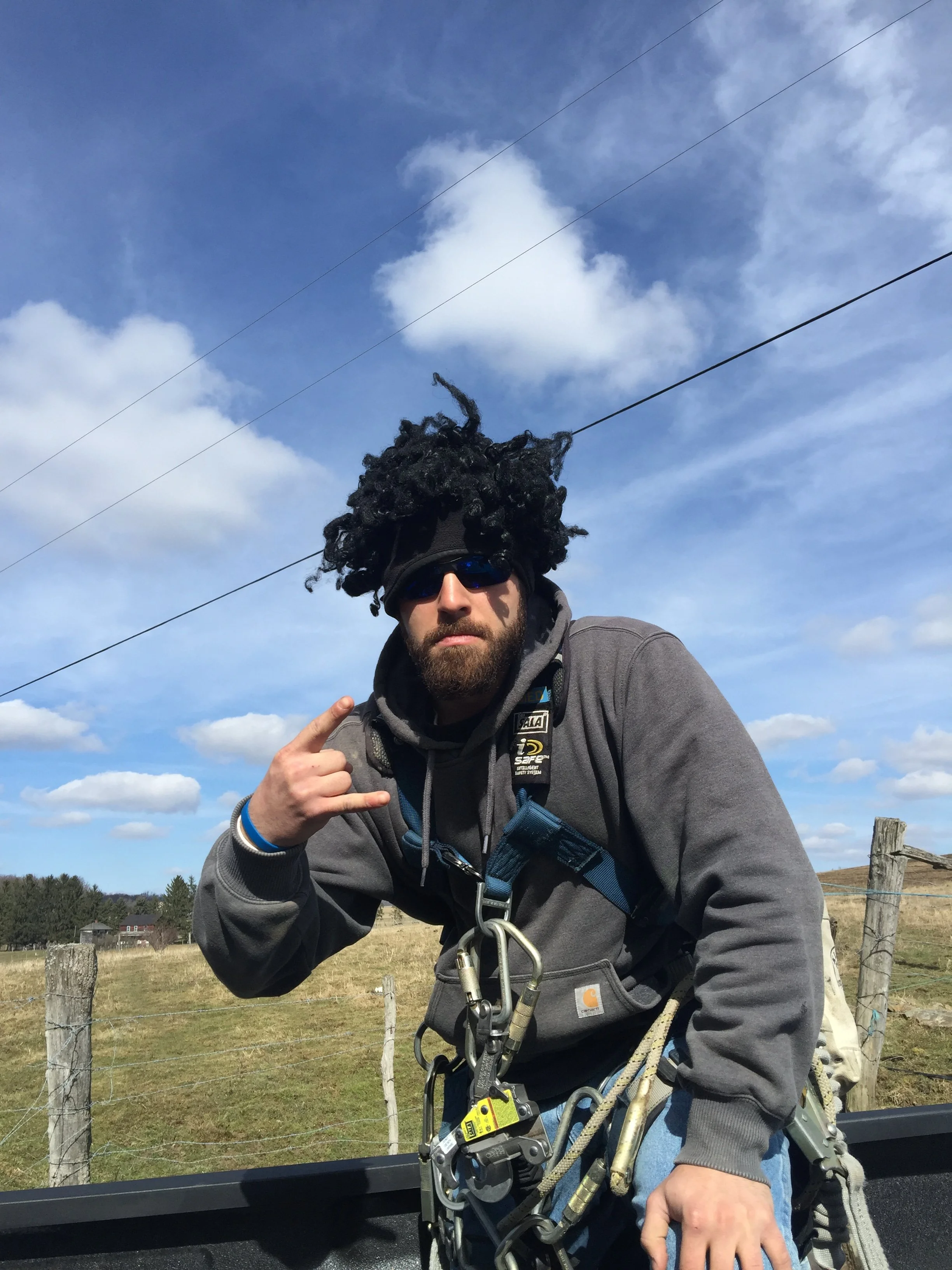
IN MEMORY OF DANNY
Daniel "Danny" Patrick Harrison
Friend. Coworker. Tower hand.
May 16, 2016
PUBLIC RECORD
For additional information about the May 16, 2016, accident:
OSHA Inspection & Investigation Record
Wireless Estimator — Two Tower Technicians Killed in Separate Incidents