AI: An Intelligent Tool. Where Does It End?
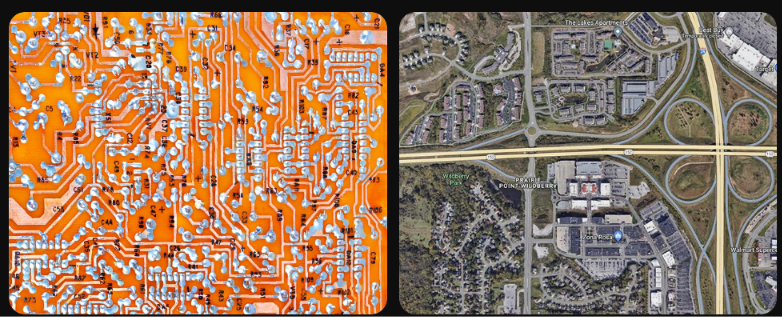
I’ve always looked at the world a little differently. When I'm driving around Interstate 465 in Indianapolis or Interstate 435 in Kansas City, I sometimes imagine what the highway system would look like from a couple of miles above the ground. All those roads, interchanges, and connections remind me of an old circuit board from a stereo receiver or some other piece of electronic equipment.
Think about it. You have individual components connected by copper traces, allowing electricity and signals to travel from one component to another. Now look at our highway system. The roads are the traces, the cities and businesses are the components, and the vehicles are carrying people, materials, equipment, and information from one place to another.
I've thought about that for years, long before artificial intelligence became part of my everyday life.
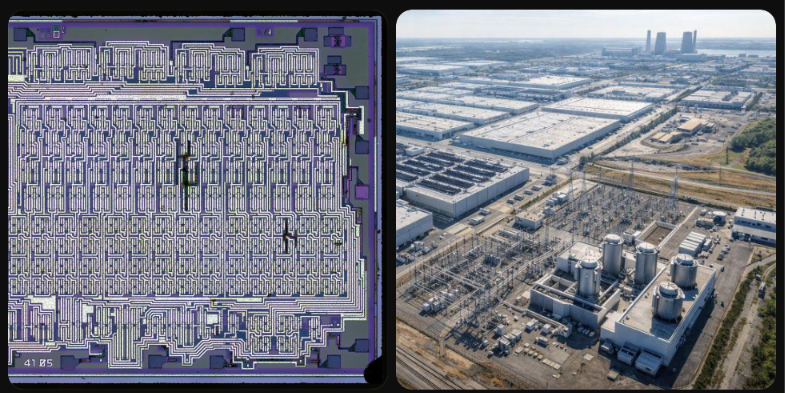
Now look at what's happening around us. We're building enormous data centers, expanding electrical infrastructure, installing fiber-optic networks, and connecting computing systems across the world. Imagine looking down at all those connections from above. In some ways, it starts looking like another enormous circuit board, only this one stretches across entire countries.
We've spent generations building the physical connections that allow our world to function. Now we're developing artificial intelligence that could eventually help coordinate much of what happens within those connections.
And that makes me wonder where all of this is going.
I'm not a computer scientist. I'm a construction guy who has spent most of his working life solving problems, managing people, and figuring out better ways to get things done. I've watched technology change tremendously over the years, but I don't think I've ever seen anything quite like the development of artificial intelligence.
Just look at how far we've come in the last couple of years.
Not long ago, most of my interaction with AI involved asking questions and getting answers. Now I can use it to help design products, develop documents, research complicated subjects, create images, and work through problems that might have taken me days to figure out on my own.
People are creating videos, building applications, developing businesses, and experimenting with things that weren't nearly as accessible just a short time ago.
And I think we're only scratching the surface.
Think About What Electricity Did
When electricity became widely available, it changed the world.
Manufacturing, transportation, communications, medicine, entertainment, and everyday life were transformed. Entire industries developed around things that previous generations couldn't have imagined.
Think about somebody living before electricity became common. Could they have imagined a modern hospital, a computer, a television, or the technology we carry around in our pockets today?
Probably not.
They might have understood that electricity was useful without having any idea what people would eventually accomplish with it.
That's how I look at artificial intelligence.
I don't believe we're anywhere close to seeing its full potential. In fact, I wonder whether we've even begun to understand what it might eventually make possible.
And unlike electricity, which provides the power to operate equipment, AI can help us analyze information, develop ideas, recognize patterns, and solve problems.
What happens when we apply those capabilities to things we've struggled with for generations?
What I've Learned From Using AI
I've been using AI quite a bit, particularly while developing some 3D-printed products and studying project management.
I can describe an idea, discuss a design, make changes, and work through problems. Sometimes it saves me an enormous amount of time. Other times we go back and forth because I haven't explained something clearly enough or the AI has misunderstood what I'm trying to accomplish.
I've learned that asking the right question makes a tremendous difference.
AI can give you an impressive answer to the wrong question. And if you don't understand the subject well enough to recognize the mistake, you could end up making a bad decision.
That's something people need to understand.
I've also been using AI to help with my education. I can ask it to explain something, give me examples, develop practice questions, or approach a subject from a different direction until I understand it.
That makes me wonder what education might look like in another ten years.
Imagine having a personal instructor available whenever you need one. It understands what you're trying to learn, recognizes where you're struggling, and adjusts the instruction to fit you.
What could that do for someone who wants to learn a trade, develop management skills, or pursue an entirely different career?
I've even wondered whether AI makes me smarter or simply gives me access to information that makes me feel smarter.
There's a difference between having an answer and understanding it.
But I also believe having access to that information creates opportunities that didn't exist before.
What Could AI Eventually Make Possible?
This is where my imagination starts getting away from me.
Imagine one person operating an entire business with the help of AI agents. One handles customer inquiries, another develops proposals, another manages scheduling, another monitors finances, and another reviews everything to identify potential mistakes.
The owner makes the important decisions while AI handles much of the administrative work.
That could give someone with a good idea the opportunity to build a business without needing a large staff or enormous financial resources.
Now take that same idea and apply it to infrastructure.
I've spent years working around telecommunications equipment, power systems, batteries, and rectifiers. Many of those systems already have redundancy built into them. If one component fails, another can sometimes carry the load while repairs are arranged.
What happens when AI begins monitoring thousands of interconnected systems, identifying problems before they occur, shifting workloads, and coordinating maintenance?
Could it eventually help manage electrical grids, transportation networks, manufacturing facilities, and entire data center operations?
Some of that automation already exists today. But imagine what it might look like thirty years from now.
And then there's science.
Could AI help scientists develop treatments for diseases we've struggled with for generations? Could it help researchers better understand cancer, genetics, aging, or the human brain?
Could it help us discover new materials, improve energy production, or develop technologies that make space travel more practical?
I've even wondered whether AI could help scientists understand animal hibernation well enough to someday develop something similar for humans traveling through space.
Or whether it could help us understand genetics so thoroughly that we could change characteristics of living organisms in ways that aren't possible today.
I once started wondering what it would take to genetically change a lion so it could survive entirely on plants instead of meat.
I know that sounds far-fetched. Changing an animal's entire digestive system and metabolism is far beyond anything we currently know how to do.
But that's my point.
I'm not saying these things are going to happen. I'm asking what might become possible when we have increasingly powerful tools helping us investigate questions we couldn't previously answer.
What if AI helps scientists discover something that changes our understanding of physics?
What if it identifies a solution to a problem that people have been trying to solve for a hundred years?
What if the biggest discoveries haven't even been imagined yet?
I don't know.
And that's what makes it exciting.
There Will Be Consequences
I don't believe all these changes will come without challenges.
AI is going to affect employment. Some people will become considerably more productive. New businesses and occupations will develop. Other jobs will change, and some will disappear.
I don't think we should pretend otherwise.
A company that once needed several people to handle scheduling, purchasing, invoicing, and paperwork may eventually accomplish much of that work with AI.
And as robotics improves, some physical jobs could change as well.
That doesn't mean every occupation will disappear. Experience, judgment, accountability, and human relationships will continue to matter.
But I think people need to recognize what's happening.
There will be opportunities for those who learn to use this technology, and there will be challenges for those whose work becomes less necessary.
We also have to consider the risks. AI can make mistakes. People can become too dependent on it. Governments and companies can restrict how it's used. And just because technology makes something possible doesn't mean we should automatically do it.
Those are legitimate concerns.
But I don't believe the answer is to ignore the technology or pretend it's going away.
Don't Sit on the Sidelines
Here's what I would encourage people to do.
Start using AI.
Not just to write an email or answer a question. Use it to learn something you don't understand. Use it to explore an idea you've had for years. Ask it to explain something complicated. Challenge the answer. Ask another question.
If you're trying to advance your career, use it to improve your knowledge and develop your skills.
If you're thinking about starting a business, explore what it might take.
If you have a problem you've never been able to solve, see whether AI can help you approach it differently.
You don't have to be a computer scientist or have a college degree to begin learning how to use these tools.
But you do have to be willing to learn.
And don't assume that because AI can't accomplish something today, it won't be able to help accomplish it in the future.
Look at how much has changed in just the last few years.
Now imagine another ten years. Or twenty. Or thirty.
Where Does It End?
I've spent a lot of time thinking about artificial intelligence, and I've reached the point where the possibilities are beyond what I can imagine.
I started with a tool that could answer questions. Now I'm watching people use AI to create images, videos, software, and businesses.
I'm thinking about AI coordinating infrastructure, helping scientists make discoveries, changing how we educate people, and potentially transforming industries that have existed for generations.
And I keep coming back to that old circuit board.
We've spent centuries building connections between people, places, businesses, and machines. Now we're developing technology that could help us use those connections in ways we've never considered.
I don't know what the ultimate limits of artificial intelligence will be. There will always be physical and practical limitations, but I believe human imagination will play an enormous role in discovering what's possible.
Think about what electricity did for the world.
I believe AI could bring about a transformation of similar magnitude, only in a completely different way.
Ten years from now, somebody might read this and laugh at how little we understood about artificial intelligence back in 2026.
I hope they do.
Because that would mean we've accomplished things I can't even imagine today.
I see tremendous value in this technology. I see opportunities for people to learn, grow, create, and solve problems that once seemed impossible.
And I believe we're only beginning to understand what we're holding in our hands.
AI is a tool. An intelligent tool. And I believe we're just getting started.